
This is the first post in our Cold Email Myths series, where we take the things everyone repeats about cold email and check them against real campaign numbers.
Every week, someone announces that cold email is dead.
Inboxes are too crowded. Spam filters are too strict. Nobody reads emails from strangers anymore. Buyers only trust referrals, LinkedIn, or content.
And every day, companies keep booking meetings, closing deals and building pipelines with cold email.
So who is right? Both, sort of. One kind of cold email really is dead. The other kind is working better than ever, because so many people gave up on it.
Why people believe cold email is dead
The myth didn’t come from nowhere. People who say it usually had a real experience like this:
- They bought a big list, wrote one template and sent thousands of emails.
- They sent from their main company domain, or one brand-new inbox.
- Replies were close to zero. Open rates looked fine, so they blamed the copy.
- They rewrote the copy. Still nothing. Conclusion: cold email doesn’t work anymore.
On top of that, the rules did change. Since 2024, Google and Yahoo introduced stricter requirements for bulk senders: authenticated domains (SPF, DKIM and DMARC), low spam complaint rates and easy unsubscribes. Microsoft followed with its own requirements. Senders who ignored the basics saw their emails quietly move to spam.
From the sender’s side, that looks exactly like “cold email is dead.” From the inbox side, it looks like “spam got harder to send.”
What actually died
Here is the kind of cold email that stopped working:
| Dead | Still working |
|---|---|
| Thousands of emails a day from one inbox | Small daily volume spread across many mailboxes |
| Sending from your main company domain | Separate, warmed-up sending domains |
| Unverified, scraped lists | Verified lists with low bounce rates |
| Generic templates about “us” | Short, plain-text emails about the reader |
| “Can we book 30 minutes?” | A small, easy question |
| Judging by open rates | Judging by replies |
The left column is spam with a sales goal. Mailbox providers got very good at catching it, and buyers got very good at ignoring it. That is a good thing for everyone who does it properly.
The proof
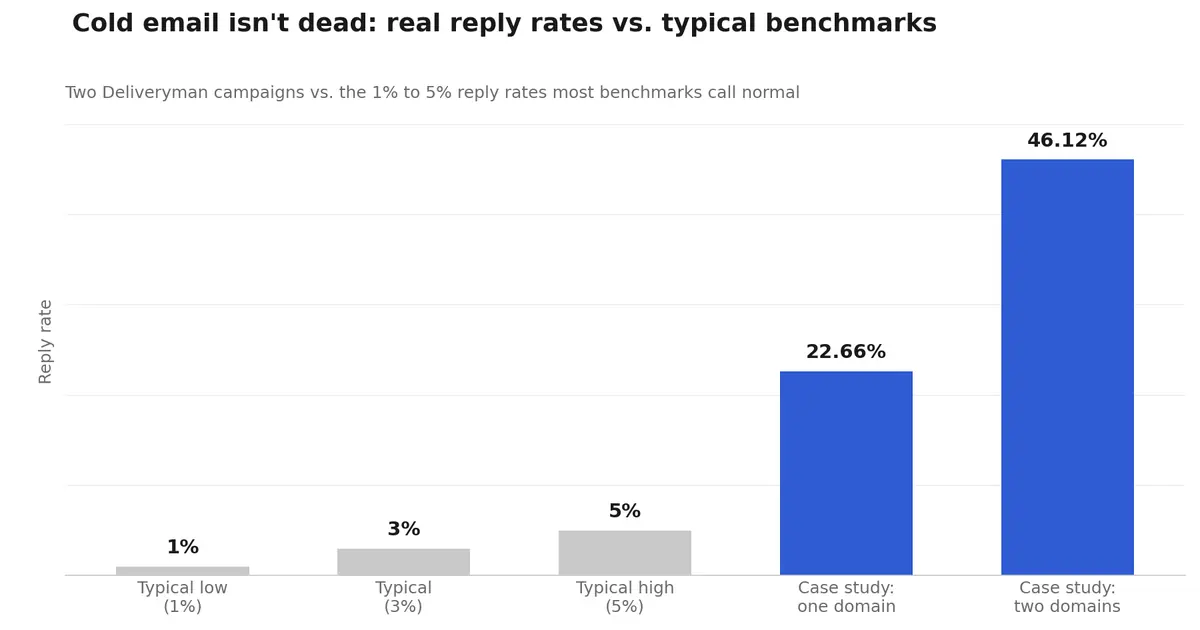
Most cold email benchmarks put a normal reply rate somewhere between 1% and 5%. Here are two recent campaigns run on Deliveryman, with numbers taken straight from the dashboard.
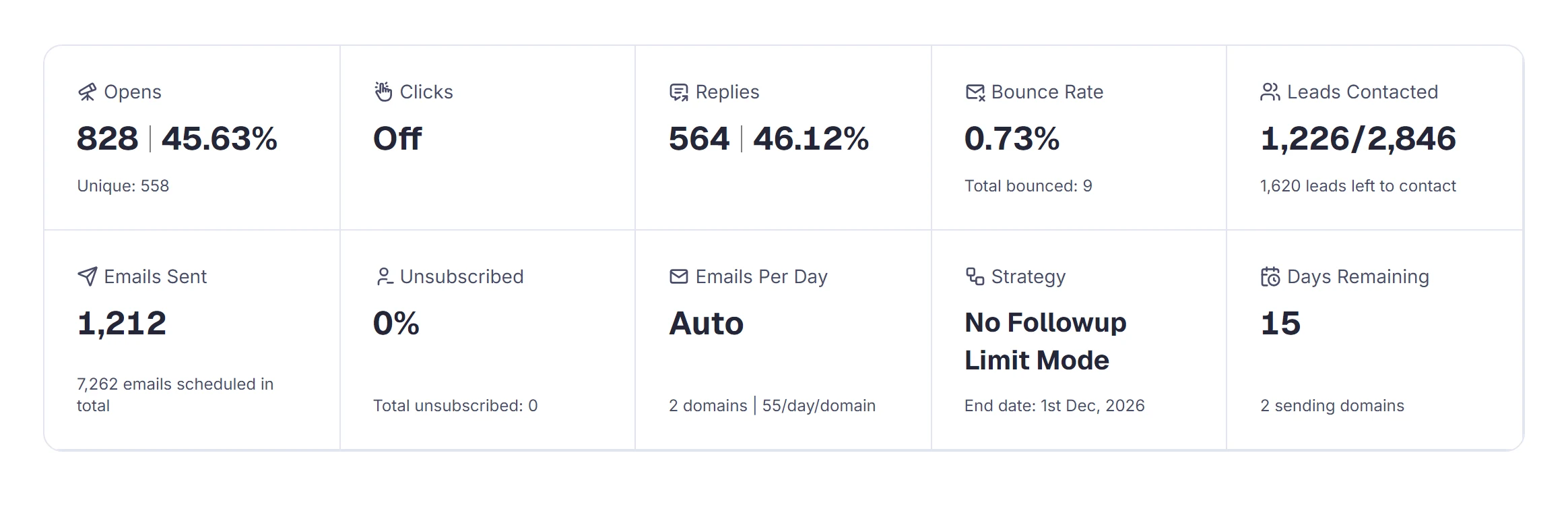
46.12% reply rate from two domains
A B2B company emailed independent publishers. These are some of the hardest inboxes in cold email: shared addresses like info@ and pr@ that get pitched all day. The campaign contacted 1,226 leads and got 564 replies, a 46.12% reply rate, with a 0.73% bounce rate.
It used just two warmed-up domains, a verified list, and a short plain-text first email that brought in 98.8% of all replies. Read the full 46% reply rate case study.
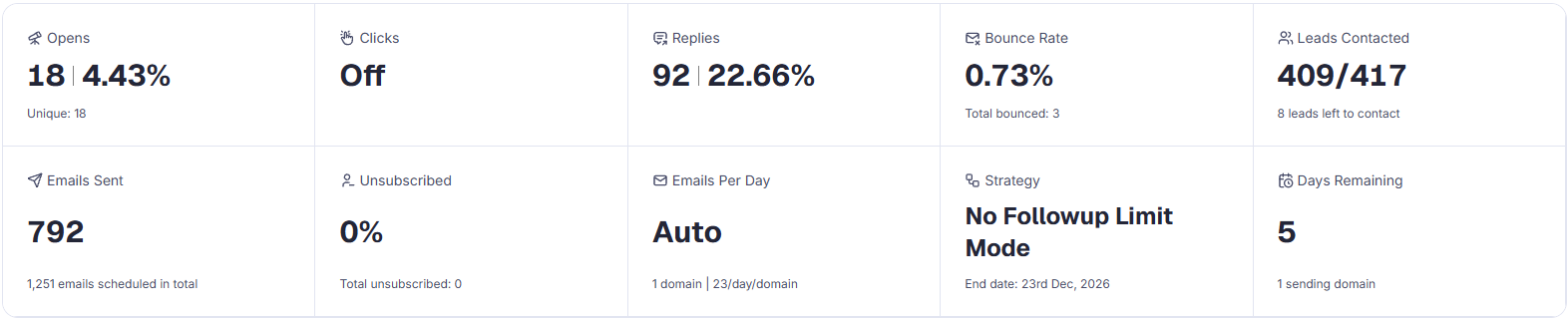
22.66% reply rate from one domain
A second campaign emailed 409 local business owners from one domain. 92 replied, a 22.66% reply rate, with 0 unsubscribes. That is about 1 reply for every 4 to 5 leads. At a typical 3% reply rate, the same 92 replies would have needed over 3,000 leads.
The first line didn’t pitch anything. It asked for help: “I’m not sure I’ve reached the right person, so feel free to forward this to whoever handles it.” Read the full 22.66% reply rate case study.
If cold email were dead, neither of these would be possible. Both are many times above the usual 1% to 5%.
What these campaigns did differently
Neither campaign relied on a clever trick. They did the same handful of boring things right.
1. They reached the inbox first
An email in spam can’t get a reply, no matter how good it is. Both campaigns sent from domains that were fully warmed up before the first cold email, with SPF, DKIM and DMARC set up correctly. Sending was spread across several mailboxes on subdomains, so no single inbox carried the load.
2. They kept volume low per domain
The one-domain campaign sent about 20 to 25 emails a day. The two-domain campaign capped new leads at 55 per domain a day. To reach more people, add domains. Don’t push more volume through the ones you have.
Pushing more emails through the same inbox looks like it should bring more replies, but it usually does the opposite: sudden volume spikes, more bounces and more spam complaints drag down sender reputation until everything lands in spam. We break down the math, including how many domains you need for a given daily volume, in Cold Email Myth #2: “More Emails = More Replies”.
3. They verified the list
Both campaigns finished with a 0.73% bounce rate. Bounces damage a domain faster than almost anything else, and a verified list kept them close to zero.
4. They wrote short emails that were easy to answer
Plain text. No tracked links. About 150 words or less. A question that takes one line to answer, instead of a request for a 30-minute call with a stranger.
5. They measured replies, not opens
Privacy features like Apple Mail Privacy Protection make open rates unreliable. A reply is the only clear sign that a real person read your email and cared.
Why “cold email is dead” is good news for you
Every team that believes the myth and stops sending leaves more room in the inbox for the teams that do it well. Stricter spam filters remove the lazy senders, and the remaining emails get more attention.
Cold email didn’t die. It just stopped rewarding shortcuts.
Quick checklist before your next campaign
- Never send cold email from your main company domain.
- Set up SPF, DKIM and DMARC on every sending domain.
- Warm up each domain fully before the first cold email.
- Spread sending across several mailboxes, and keep daily volume low per domain.
- Verify your list and keep bounces under 2%.
- Write short, plain-text emails about the reader, not about you.
- Ask for the smallest possible next step.
- Stop follow-ups as soon as someone replies.
- Judge the campaign by replies.
Next in the series: Cold Email Myth #2: “More Emails = More Replies” (How to Scale Cold Email). Why sending more from the same inbox lowers your replies, and how adding domains lets you send more safely.
Want to skip the setup? You bring one domain. Deliveryman builds your mailboxes, sets up your DNS, warms up your domain, verifies your list and spreads your sending across mailboxes. See pricing.