
This is the fifth post in our Cold Email Myths series, where we take the things everyone repeats about cold email and check them against how inboxes actually work.
Most people treat email warm-up like a setup step. Buy a domain, add mailboxes, warm them up for two or three weeks, then switch warm-up off and start sending. Done.
It feels logical. Warm-up got the mailbox ready, so why keep paying for it? But sender reputation isn’t something you earn once and keep. It’s a running score, and cold email pushes it down every single day.
What email warm-up actually does
A new mailbox has no history, so Gmail and Outlook don’t trust it. Warm-up builds that history by sending small amounts of email between real inboxes that open it, reply to it, and move it out of spam when needed. To a mailbox provider, that looks like a person whose email people want.
The key word is history. Providers mostly judge you on recent behavior. A great month in the past doesn’t protect you from a bad month now.
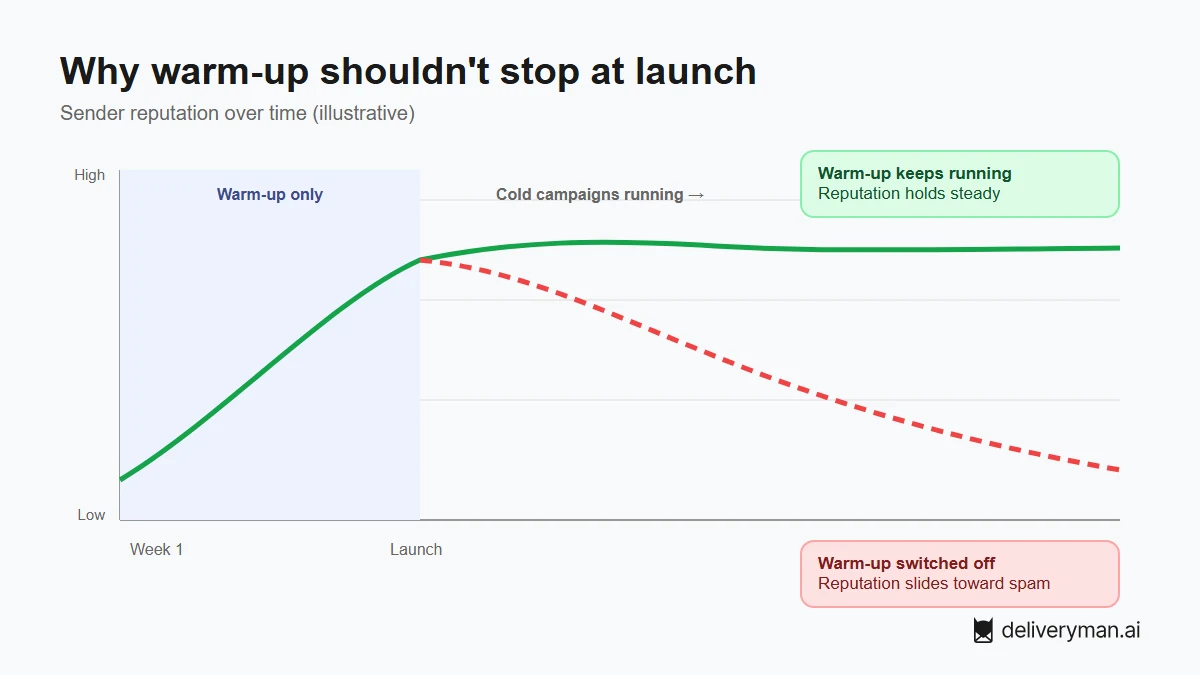
Why warm-up shouldn’t stop at launch
1. Cold email is mostly negative signals
Even a good cold campaign gets a lot of silence. Most recipients don’t open, few reply, and some delete without reading. A handful mark it as spam. Warm-up is the steady stream of positive engagement that balances that out. Turn it off and the balance tips.
2. Reputation reflects recent behavior
Mailbox providers care most about how your email has performed lately. If your last few weeks are all cold sends with low engagement, the good warm-up history from before launch fades fast.
3. The drop is quiet
Nothing bounces. Your sending tool still shows “delivered.” Reply rates just slowly fall as more email lands in spam. By the time you notice, the mailbox needs weeks of recovery.
4. Paused mailboxes go cold again
If you rest a mailbox between campaigns with no warm-up running, it loses its recent history. When you start again, it behaves like a new mailbox, and a sudden burst of cold email from it looks suspicious.
What a healthy mailbox looks like after launch
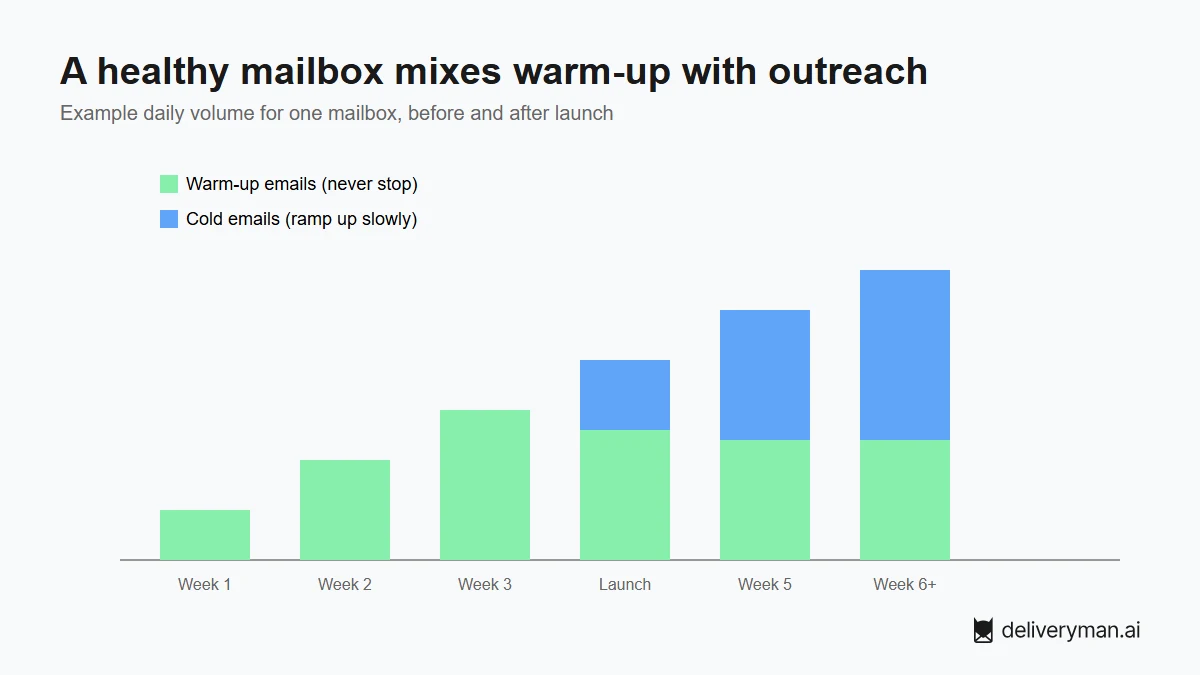
Warm-up doesn’t stop at launch. It shifts from being the main thing the mailbox does to running quietly alongside your campaigns. For example, a mailbox might:
- Weeks 1–3: warm-up only, ramping up a little each day.
- Launch week: a small number of cold emails per day, with warm-up still running.
- After that: cold volume grows slowly to a safe daily limit, and warm-up keeps going every day.
How to keep email warm-up working long term
- Never turn warm-up off on an active mailbox. Keep it running for as long as the mailbox sends cold email.
- Ramp cold volume slowly. Add a few emails per day each week instead of jumping to full volume on day one.
- Keep daily limits low per mailbox. Spread volume across more mailboxes instead of pushing one harder.
- Keep warm-up running on paused mailboxes. A resting mailbox should still have a steady, healthy history when it comes back.
- Watch reply rates, not just delivery. A slow drop in replies on one mailbox is often the first sign of a reputation problem.
- Re-warm before restarting. If a mailbox sat idle with no warm-up, treat it like a new one and ramp up again.
“Doesn’t ongoing warm-up look fake?”
Good warm-up looks like normal email: varied content, natural timing, real replies and a volume that fits the mailbox. What looks unnatural is the opposite pattern: a mailbox that sent nothing but warm-up for three weeks, then switched to nothing but cold email overnight.
FAQ
How long should you warm up a new email account?
Usually two to four weeks before sending any cold email. After that, keep warm-up running for as long as the mailbox is in use.
Should I stop email warm-up after my campaign starts?
No. Cold email brings low engagement and some spam complaints. Ongoing warm-up adds positive signals that keep your sender reputation balanced.
What happens if I turn off warm-up?
Usually nothing visible at first. Over the following weeks, more emails land in spam and reply rates drop, even though your tool still shows them as delivered.
Do I need to warm up a mailbox again after pausing it?
If warm-up kept running during the pause, no. If the mailbox sat idle, ramp it back up slowly before sending cold email again.
Next in the series: Cold Email Myth #6: Longer Emails Convert Better.
Deliveryman keeps warm-up running on every mailbox, before and after launch. You bring a domain, and it sets up 15 mailboxes with SPF, DKIM and DMARC, warms them up and spreads your sending so no mailbox carries too much. See pricing.