
If you work with cold email or run email infrastructure, you will eventually come across different blocklists.
One name that shows up often is UCEPROTECT, especially UCEPROTECTL3.
For many people, seeing their IP on a blacklist immediately causes panic.
But in reality, UCEPROTECTL3 is usually not something you need to lose sleep over.
Let’s explain why.
What is UCEPROTECTL3?
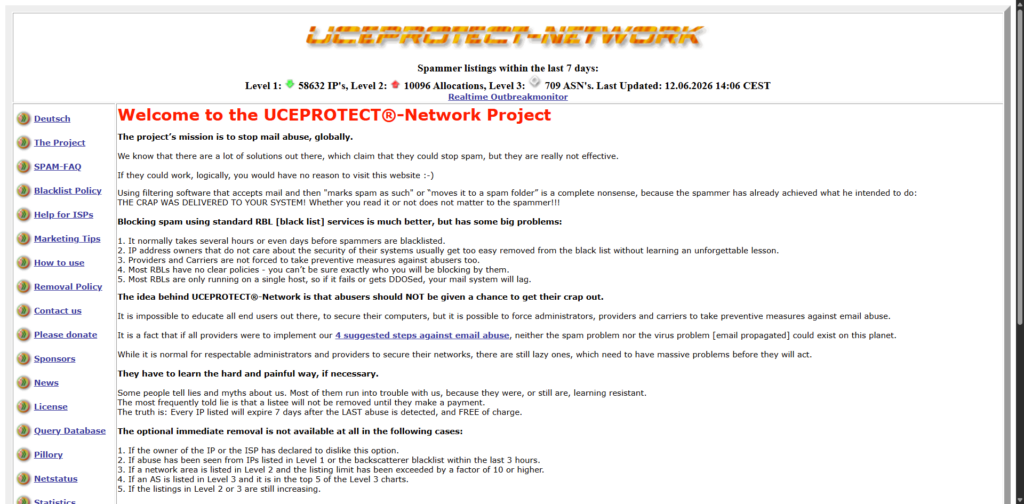
UCEPROTECTL3 is a Level 3 blocklist.
Unlike many other blocklists that list individual IP addresses, UCEPROTECTL3 lists entire subnet ranges.
This means your IP can appear on the list even if your own server is behaving perfectly.
Imagine this situation:
Someone in your apartment building plays extremely loud music at 3 AM.
Instead of knocking on their door, the building manager decides the whole building is now suspicious.
That is essentially how UCEPROTECTL3 works.
If someone on the same network range sends spam, the entire subnet can get listed.
So your IP might be listed simply because another user in the same ISP network misbehaved.
Why major email providers rarely rely on it
Modern email providers care about accurate reputation signals.
They look at things like:
- IP reputation
- domain reputation
- sending patterns
- recipient engagement
These signals tell them how you behave as a sender.
A rule like
“someone on this subnet sent spam, so everyone must be bad”
is simply too broad to be reliable.
Because of this, many major providers no longer treat subnet-level listings as a strong signal.
What this means in practice
At Deliveryman AI, we constantly monitor IP reputation and deliverability signals.
Sometimes you may see an IP appear on UCEPROTECTL3 during checks.
When that happens, it can look alarming on a dashboard.
But in most cases, it does not actually impact inbox placement with major email providers.
Your deliverability is determined much more by:
- Your sending behavior
- your domain reputation
- proper IP warmup
- consistent sending patterns
Not by what someone else did on the same subnet.
The real focus for deliverability
Instead of worrying about broad subnet listings, the real focus should always be on healthy sending practices.
That means:
- warming up IPs properly
- sending gradually
- maintaining good engagement
- protecting domain reputation
Those are the signals that actually matter.
Blocklists can look intimidating, especially when you first encounter them.
But not all blocklists carry the same weight.
UCEPROTECTL3 often falls into the category of “looks scary but rarely critical.”
How Deliveryman AI helps?
At Deliveryman AI, we monitor multiple blacklist and reputation sources automatically, including UCEPROTECT, Spamhaus, Barracuda, and other major deliverability signals.
But more importantly, we help you focus on what actually impacts inbox placement:
- Automated IP and mailbox warmup
- Continuous blacklist monitoring
- Domain health tracking
- Email authentication management (SPF, DKIM, DMARC)
- Sending infrastructure built for deliverability
Because successful cold email isn’t about chasing every blacklist notification. It’s about maintaining a healthy sending reputation over time.