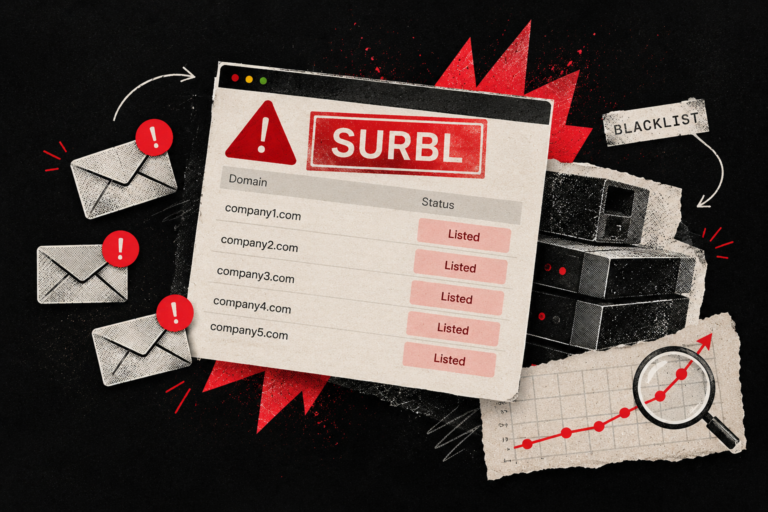

short answer: a SURBL listing will not stop you from reaching Google or Microsoft inboxes.
it can hurt with Yahoo/AOL infrastructure and some third-party filters.
don’t panic. keep sending.
but something changed, and it’s worth understanding.
domains are no longer only getting listed one by one.
they’re getting listed in batches.
the new pattern: batch listing
a lot of senders buy a stack of lookalike domains around one brand.
same day. same registrar. same nameservers. same hosting IP.
then every domain redirects to the main site.
to a human, that’s five domains.
to a filter that correlates infrastructure, that’s one operation.
flag one, and the rest get dragged in.
the signals that group your domains together
- lookalike names around one brand, often with a hyphen, a number or a common-word prefix
- many domains registered on the same day
- one registrar, one set of nameservers, one hosting IP
- brand new domains, often on cheap TLDs
- every domain redirecting to the same main site
one signal alone means little.
five at once looks like a pattern.
SURBL doesn’t publish its exact rules, so treat this as what we infer, not a spec.
why a domain can be listed even if you never spammed from it
SURBL builds its data from its own research, passive DNS, TLD zone files, outside phishing and malware trackers, spam traps and honeypots.
a domain can show up because of what it’s connected to.
not only because of what you sent.
first: check the right domains
SURBL doesn’t look at your sending IP.
it looks at domains inside the message body.
so check every link domain in the raw HTML:
- your tracking domain
- any redirect domain in the chain
- your unsubscribe link
- your landing page
a sender-only domain that is never linked gives SURBL nothing to act on.
how to build domains that don’t look like a batch
- diagnose first. find which link domain is listed before you change anything.
- stop buying more domains on the same infrastructure.
- spread registrars, nameservers and hosting IPs.
- stagger registrations. don’t buy everything in one afternoon.
- age new domains about 30 days before you link them in email.
- first touch in plain text. no links, no pixels.
- fix the root cause before you request removal. a delisting without a fix gets relisted.
the goal is simple.
every domain should look like its own small business.
where SURBL came from
it starts with SpamAssassin.
1997: a spam filter script called filter.plx begins.
April 2001: it’s rewritten and released publicly as SpamAssassin.
summer 2004: it joins the Apache Software Foundation.
back then, filters shared spam domains as hand-maintained text lists.
in April 2004, SURBL was announced to SpamAssassin users as a better way.
one live list. checked with a DNS lookup.
it was the first major URI DNSBL, a blocklist of domains found inside message bodies.
what SURBL is today
it grew from one list into a reputation and intelligence service.
APIs, DNS feeds, RPZ and rsync. most current uses aren’t even email.
- ABUSE: spam and abuse domains
- PH: phishing
- MW: malware
- CR: cracked sites
- CT: click trackers, including spam-trap mailers
- DM: disposable email
they combine into one DNS zone, multi.surbl.org.
a lookup is just a DNS query. the answer is a bitmask that says which lists matched.
data refreshes in well under a minute, and subdomains of a listed domain match too.
restricted datasets exist as well, including one for recently registered domains.
does a listing actually hurt?
it depends on who is filtering.
Google and Microsoft are most of the market, and in what we manage, a SURBL listing doesn’t show up as a delivery problem there.
the effect shows up with Yahoo/AOL infrastructure and some third-party filters.
it’s one signal among many, not a verdict.
what we’ve seen at Deliveryman
we manage the whole sending infrastructure.
we’ve seen other platforms get hit by SURBL.
we haven’t seen that with Deliveryman.
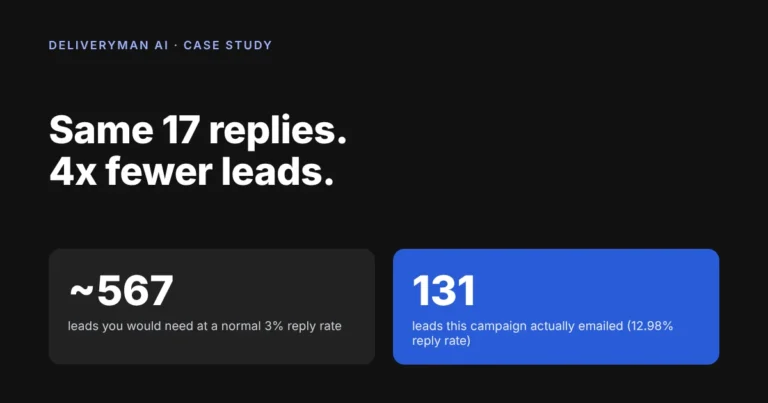
many of our users arrived with domains already on SURBL.
they sent through Deliveryman anyway.
they got great results.
the bottom line
don’t pause your campaigns over a listing.
do check your link domains, and stop building batches that look like one.
keep sending. keep booking deals.
want infrastructure that’s built to look independent from day one? start with Deliveryman.